How to Get Forklift Certified and Find Forklift Jobs in Dalton, GA
Dalton is one of the Southeast's most active manufacturing markets — home to carpet and flooring plants, a major solar panel facility, chemical manufacturers, automotive parts suppliers, and more. These facilities run multiple shifts year-round and consistently need certified forklift operators.
This guide covers what you need to know: how certification works, what equipment you'll run, what it pays, and how to find a job.
What Forklift Certification Is — and What It Isn't
There is no state-issued forklift license in Georgia. You won't get one from a DMV or any government office — that's a common misconception worth clearing up early.
What does exist is a federal requirement under OSHA Standard 29 CFR 1910.178. Before anyone operates a powered industrial truck independently, their employer must train them, evaluate them, and certify them. No exceptions — not for age, not for experience, not for anyone.
The certification comes from your employer, not the government. OSHA writes the rules. Your employer — or a qualified trainer they bring in — does the actual training and signs off on your certification.
That certification needs to have your name, your training date, your evaluation date, and your trainer's name on it. It only covers the specific type of forklift you were trained on, and it needs to be renewed every three years.
The 3 Steps to Getting Certified
Step 1: Formal Instruction
This is the classroom portion — the concepts, the rules, the safety principles. You can complete it online or in person; OSHA allows both. Topics cover forklift controls, load capacity, tip-over prevention, pre-operation inspection, pedestrian safety, and OSHA regulations. Finishing this step alone doesn't certify you — it's just the foundation.
Step 2: Hands-On Training
This is where you actually get on the machine. A qualified trainer shows you how it's done, then puts you behind the controls and watches. You'll practice the pre-shift inspection, moving with and without a load, picking and placing pallets, working around other people, and proper shutdown. This happens on real equipment, in the actual workplace.
Step 3: Performance Evaluation
A qualified person watches you operate and formally signs off that you can do it safely. Once you pass, the employer documents it and you're certified to run that equipment independently.
Total time: Most employer onboarding programs get it done in one day.
How Certification Works in Practice
Some employers in the Dalton area require candidates to arrive already certified to prove experience. But, under OSHA, the employer is responsible for training and certifying operators on their specific equipment — so they bring you on, put you through their program, and certify you before you operate independently. This is standard practice, not an exception.
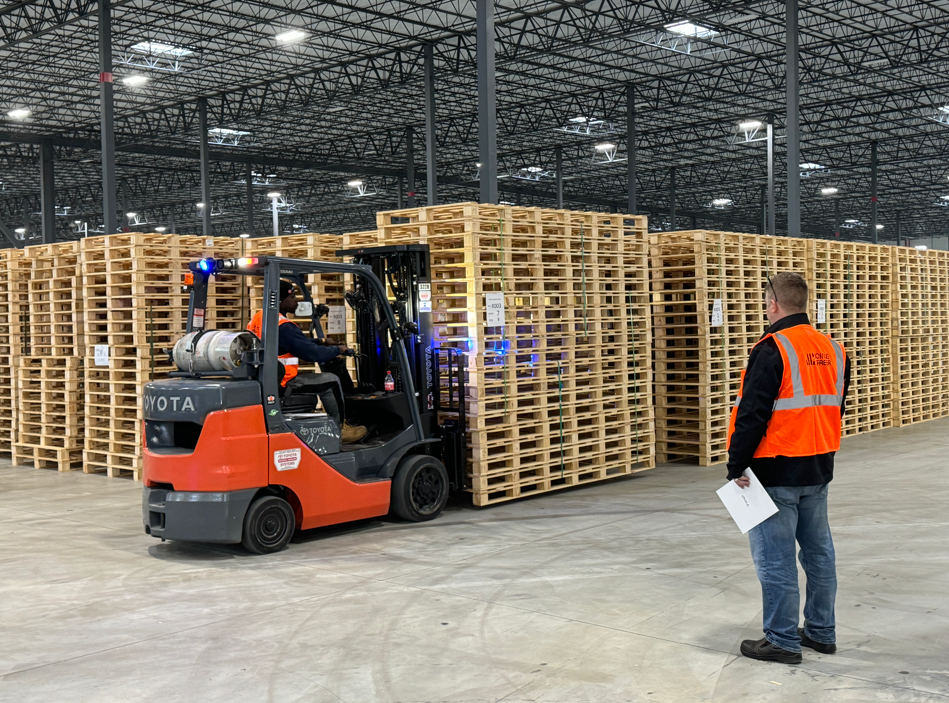
A huge thank you to our exceptional trainer, Ken Sullivan, for his guidance and expertise throughout the forklift certification test process. Ken often trains the trainer.
If you want to build foundational knowledge before applying, Georgia Northwestern Technical College (GNTC) offers a Forklift Operator course (FLO) open to individual learners. The course covers classroom instruction, a written test, hands-on practical training, and a performance evaluation on an LP gas counterbalanced forklift — fully OSHA compliant. Upon completion, you receive a lift truck certificate. Individual learners can register online at ce.gntc.edu.
Employers will recognize the GNTC certificate as valid training — though per OSHA, they will still conduct a brief workplace evaluation before you operate independently on their floor.
OSHA-compliant online formal instruction courses are also available. Look for providers that explicitly reference OSHA Standard 29 CFR 1910.178. Keep in mind that online coursework only satisfies Step 1 — your employer will still conduct the hands-on training and evaluation before you operate independently.
Equipment You'll Encounter in Dalton Facilities
OSHA classifies powered industrial trucks into seven classes. Here are the ones you'll most commonly run in Dalton — and why:
Class I — Electric Motor Rider Trucks Battery-powered counterbalance forklifts, sit-down or stand-up. Among the most common machines you'll run in the area. Both carpet manufacturing and solar panel production happen in large enclosed facilities where clean, quiet operation matters — no exhaust fumes, no noise interference. Class I forklifts are generally preferred for these environments.
Class II — Electric Motor Narrow Aisle Trucks Reach trucks, order pickers, and turret trucks. Less common in Dalton's manufacturing-heavy environment, but you'll encounter them in distribution and fulfillment facilities where high-density racking requires tight aisle navigation. Requires specific training — handles very differently from a sit-down machine.
Class III — Electric Motor Hand/Rider Trucks Electric pallet jacks and walkie stackers, operated by hand lever while walking or riding. Found in virtually every warehouse, receiving dock, and staging area in the region regardless of industry. Typically used for moving materials short distances within the floor. A common starting point for new operators.
Class IV — Internal Combustion Trucks (Cushion Tires) LP gas sit-down forklifts with solid tires. Well suited to Dalton's carpet manufacturing plants, which involve moving heavy rolls of carpet and raw materials across large indoor production floors. GNTC's local forklift certification course specifically trains on LP gas counterbalanced forklifts — a direct reflection of what the local market uses.
Class V — Internal Combustion Trucks (Pneumatic Tires) Air-filled tires built for outdoor surfaces. Typically used at loading docks and outdoor storage yards across manufacturing facilities in the area, where operators move materials between the warehouse floor and truck trailers or outdoor staging areas.
Your certification covers only the class of equipment you were trained and evaluated on. Moving to a different class requires new training and evaluation — even for experienced operators.
What Forklift Operators Earn in Dalton, GA
Forklift operators in the Dalton area earn around $18 an hour for day shift — that's roughly $37,080 a year.
Your actual pay depends on which equipment you're certified on, how much experience you bring, and what shift you work. Night shift is $1 more, overtime is common in manufacturing, and operators who move into lead or supervisor roles earn more over time.
How to Find Forklift Jobs in Dalton
Apply through Joinus Career. We work directly with manufacturers and warehouses in the Dalton area and place candidates in a variety of roles. Safety isn't an afterthought here — it's one of the most important things we look at when matching candidates with employers. When you're choosing where to work, the safety culture of that workplace matters. We take that seriously, and so should you. Apply here →

At Joinus Career, safety isn't just a requirement — it's rewarded. Congratulations to Malik Lynch on earning his 30-Day No Forklift Accident Bonus.
Search job boards. Search "forklift operator Dalton G" or "lift truck operator Dalton GA" on Indeed, ZipRecruiter, or Glassdoor. Openings in this area are consistent year-round.
Apply directly. Most employers in the area post openings on their own career pages. If you have a specific company in mind, go directly to their site.
Walk in. In Dalton's manufacturing culture, showing up in person with your documentation still works and is respected by many hiring managers.
Looking beyond Dalton? Joinus Career also works with employers in the Cartersville, GA area. Check out our Complete Job Seeker's Guide to Cartersville for opportunities in that market.
What to Know Before Day One
Bring steel-toed boots and your PPE provided by Joinus Career Every facility requires them, and some will turn you away at the door without them
Do your pre-shift inspection every single day. OSHA requires it. Before each shift, walk around the machine and check fluid levels, forks, mast, tires, seatbelt, horn, and lights and security cameras, and complete the daily forklift log book (it can be found on the machine). If something's off, tag the machine out and report it — don't get on it.
Most facilities run around the clock. Second and third shifts have more openings and pay more. If you're flexible on hours, say so — it opens more doors.
There's a path forward if you want it. Reliable operators move into lead, trainer, and supervisor roles. It's not guaranteed, but it happens — and it starts with showing up and operating safely.
Quick FAQ
Do I need a driver's license? Not under OSHA. Some employers may require one as their own policy — confirm when you apply.
Can I be under 18? No. Federal law prohibits anyone under 18 from operating a powered industrial truck. No exceptions.
How long does certification last? Three years. Refresher training is also required after an accident or near-miss, observed unsafe operation, or assignment to a different equipment class.
Does certification from a previous employer transfer? Your formal instruction documentation follows you. However, a new employer is required by OSHA to evaluate your performance on their specific equipment in their workplace before authorizing you to operate independently. Bring your paperwork.
What's the difference between a reach truck and a standard forklift? A reach truck (Class II) is a stand-up electric machine built for narrow aisles — the forks extend outward into racking. It handles very differently from a sit-down counterbalance. Certification on one does not qualify you for the other.
Ready to Apply?
Joinus Career connects forklift operators with manufacturers and warehouses across the Dalton, GA area. Whether you're just starting out or looking for your next opportunity, we can help you find the right fit.